Showing posts with label dating. Show all posts

Monday, April 6, 2009

Graphic Novel 3


Mariko Tamaki's Skim, illustrated by Jillian Tamaki, tells the story of Kimberly Keiko Cameron who is nicknamed Skim by her classmates because she isn't slim. Skim wants to be a Wiccan and dresses like a Goth, so when a suicide awareness group forms at her high school they assume she must be depressed and in need of an intervention. Nothing could be further from the truth. Skim is confused and questioning but she is resilient and high spirited.

Skim finds she is growing further and further apart from her best friend, Lisa Soor, and feels like there are few people in her world who comprehend her point of view. Free spriited Ms. Archer, who teaches English and Drama, really connects with Skim on a deeper level, which causes Skim to think about her sexuality.

The book deals with first loves and heartaches (gay and straight) as well as suicide, popularity and cliques while remaining hopeful about the power of human connection to help us through it all. Highly recommended for ages 14-18.

The details: Tamaki, Mariko and Jillian Tamaki. Skim. Toronto: Groundwood, 2008.

Sunday, April 5, 2009

Series Fiction


8:00 p.m.
The only nice person is Libby. She was stroking where my eyebrows used to be and then she went off and brought me a lump of cheese. Great. I have become ratwoman.

My first introduction to Louise Rennison's Angus, thongs and full-frontal snogging came from a friend who held the book up to me and said, "this will make you blow snot bubbles out of your nose. Do not read this on the bus." He was right. Well, not about the snot bubbles, but about the hilarity that is the life of Georgia Nicolson.

The book is written in diary format, somewhat the way Bridget Jones would have described her angst-ridden life as a 14-year-old girl (complete with worries about her nose/body/skin/breasts and the mysteries of the male gender). Georgia's life is full of things she simultaneously loves and hates, like her parents, boys and her half-Scottish wildcat Angus who stalks her legs as if they were wild game.

My one quibble with the book is that sometimes Georgia struck me as a wee bit too egocentric and unaware of how her actions affected other people. Some of the comments she makes to her father or "Nauseating Pamela Green" reek of insensitivity (but then again, I suppose most 14 year old girls are slightly unaware how unkind their actions can be). I was also a little uncomfortable with the recurring jokes about lesbianism. I like to hope we're a little more socially aware these days.

However, when all is said and done the book is literally laugh-out-loud funny. I dare you to read the scene where Georgia meets her crush, Robbie, with her three year old sister Libby in tow and not guffaw or at least cackle a bit. Recommended for ages 13 to 18.

And if you like this one, later books in the series include On the Bright Side, I'm Now the Girlfriend of a Sex God; Knocked Out by My Nunga-Nungas; Dancing In My Nuddy Pants; Away Laughing on a Fast Camel; Then He Ate My Boy Entrancers; Startled by His Furry Shorts; and Love is a Many Trousered Thing.

The details: Rennison, Louise. Angus, Thongs and Full-Frontal Snogging. New York: HarperTempest, 2001.

Friday, April 3, 2009

Realistic Fiction


Clearly, these Blondes, my Blondes, were a whole lot more complicated then they looked.


When I began reading Teresa Toten's Me:) and the Blondes I thought I knew exactly what I was getting into but, it proved me wrong. Funny enough, that's exactly the point of the book.

Pink cover. Smiley face. One lunch bag representing what it means to be different in a school full of bland boring similarities. I thought this would be your stereotypical, run-of-the-mill, Mean Girls-esque tale about a young woman who's gone to a million different schools and figures out the "rules" of becoming popular (i.e. attach yourself to the blondes). At first Sophie Kandinsky feels this way but as she gets to know the blondes she discovers they are not, in fact, interchangeable pod people. They all have dramas equal to her own, including bulimia and a secret family history. Sophie comes to understand how everyone struggles just as hard to get by.

Sophie has not had an easy go of it. It’s the 1970s, she is Bulgarian-Canadian and her father has been wrongly imprisoned. Her mother, an obvious immigrant (her accent is rendered phonetically by Sophie in the book) , attempts to live her life as a single parent and wife of a convicted felon. Sophia watches her mother fall to pieces after each weekly call from her father and somehow has to make a go of it at school while holding everything together at home, working a part-time job at Mike's soda fountain, playing varsity basketball and trying to avoid letting the truth about her life seep into the high school rumour mill.

The book examines the ways we hide behind secrets but also how we can overcome these barrier by forming open and trusting bonds with others. Me:) and the Blondes is a coming of age story replete with all the awkward girl moments: first make out, first tampon, embarassing parents, the rules of slow dancing. Toten's book is recommended for 12-16 year old girls encountering the same sorts of firsts. It will make you laugh but it will also make you think and that's always a good combination (for dating or reading).


The details: Toten, Teresa. Me and the Blondes. Toronto: Puffin Canada, 2006.

Controversial Book

Later, Grandma said, "He's a nice boy, Kath."
"I know." "Intelligent."
"Uh huh." "Attractive, too."
"I agree." "Just be careful...that's my only advice."
"Of what?' "Pregnancy."
"Grandma!" "And venereal disease."
"Does it embarrass you to talk about it?"

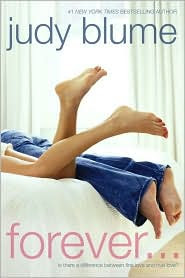
Judy Blume's Forever... examines how Katherine Danziger decides whether to have sex with her first long term boyfriend, Michael Wagner. Katherine and Michael are seniors and they have a caring, committed, mutually respectful relationship. Katherine is lucky enough to have a family, and particularly a grandmother, who want the best for her and are willing to talk openly about taking her relationship to a sexual level. Her grandmother is very active in Planned Parenthood and the National Organization of Women and she wants to make sure that Katherine will take care of her health and her future.

When Forever... was written in the mid-1970s, it caused quite a stir because the teens here talk openly and honestly about sex (although there are a few mutual orgasms occurring that may not necessarily reflect the reality of sex for those new to the act). It almost seems like a throwback now and it is hard to believe the book caused such a stir. A warning though, there are scenes of sexuality (although they are treated in a responsible way) and not all parents may approve because of these situations. They should, because, honestly, this is the frank talk they must have with their kids about how to protect themselves.

The book does not try to say this is right or wrong for everyone but rather a personal decision between two people. Blume also takes care not to trivialize the love you are capable of having at 17. It doesn't necessarily work out for everyone but that doesn't mean that it isn't just as overwhelming or an important, epic, part of our lives.

Forever...
should be recommended reading for 14 to 16 year old women and men because it demonstrates not only how to make an important decision in a mature and responsible way but it does it without reading like a brochure from a sexual health centre or a poorly acted after school movie. The moral doesn't hit you over the head because Blume is a skilled enough writer that the characters come to life for her readers, who will agonize over where Michael and Katherine's relationship will take them once they graduate.

The details: Blume, Judy. Forever. New York: Simon Pulse, 1975.

Thursday, April 2, 2009

Hi/Lo Book


I was relieved we were okay. Still, something in me kept saying, He took off and left me alone out there. Why didn't he say he was sorry?

Beth Goobie's Kicked Out tells the story of 15-year-old Dime, a Winnipeg girl who often feels she's worth about as much as her nickname dictates. Dime worries that her family cannot be normal, and fears that as much as she would love to get along with her parents, they may be doomed to yell and scream forever. She also fears that her boyfriend, Gabe, will return to his ex-girlfriend and that the ex is going to pound her face in outside of school. Things come to a head when she comes in three hours past her curfew one Friday, only to find her college-aged brother Darren waiting there the next morning, ready to help her move into his apartment.

Darren and Dime's relationship is different from the one she has with her parents. Although he can be authoritative, he never puts her down or makes her feel stupid. Sometimes it feels as if he is the only person in Dime's world who doesn't feel she's a freak or an alien. Darren is also a quadriplegic, paralyzed when he hit a moose while driving with a young Dime in the back seat. Dime sometimes wishes that she had been the one to lose her limbs since she thinks everyone believes she is a waste of space anyways. Can Darren help her to see her true value? Is it possible she can turn this whole mess around and escape grade ten?

Kicked Out is part of the Orca Soundings series of Hi/Lo books for readers looking for shorter, plot-driven, exciting reads. This book will resonate with 13-16 year old young adults who find themselves at odds with the world because they dress "differently" from the mainstream crowd (skulls, nose piercings, metal t-shirts) or girls who find themselves dealing with a boyfriend who is sometimes great and sometimes frustrating or just plain wrong for them.

The details: Goobie, Beth. Kicked Out. Victoria: Orca, 2002.

Graphic Novel


Sometimes I wonder: Can I go through with it? Am I committed to art all the time? Does art save? And is it going to save me?

Cecil Castellucci, a French Canadian author who now makes her home in LA, has written a funny and fun story about a girl named Jane whose world is turned inside out by a terrorist attack in Metro City (clearly an analogy for NYC). Jane's parents move to Kent Waters, Suburbia, in a misguided attempt to find somewhere where they can shield themselves from the true nature of violence in our world, as Jane notes, "as if ANYWHERE is really safe."

Jane's life is altered not just by the physical reality of the move but by seismic shifts in her own values. She immediately cuts her long blonde hair and dies it black in an attempt to signify to the outside world that something new has happened and the girl she was before died in the explosion. Jane begins to notice all the little bits of beauty that we take for granted. In the aftermath of the attack, she cradles one tiny, hardy, LIVING dandelion that managed to grow out of the steel and concrete death of the city. And she adopts the man whose life she's saved, a man now named John Doe, whose sketchbook she brings with her to suburbia.

Rather than fit in with just anyone, Jane holds out for kindred spirits. She fills the sketchbook with their dreams for a better world, a place where public acts of art bring colour and life to dreary, dying cities devoid of personality. Of course, not everyone welcomes creativity. The police begin to crack down on what they deem to be defiling of public property and the P.L.A.I.N. gang find themselves confronted with a choice: give in and live the lives expected of them or continue to be an "art girl gang." (And I use the term girl lightly since their members include the school's only openly gay male and they embrace the help of all of the teens in the city).

This book is funny and funky and highly recommended for anyone interested in the effects of art, terrorism or high school cliques on the human psyche. All ages.

The details: Castellucci, Cecil and Jim Rugg. The Plain Janes. New York: Minx, 2007.

Wednesday, April 1, 2009

Romance


We kiss like it's a form of clasping.

Rachel Cohn and David Levithan's Nick & Norah's Infinite Playlist is infinitely better than the movie version by the same name. The book alternates between his and her points of view and explores what happens when two people somehow manage to connect. Really connect. The conversation between them is at times flirtatious, witty, angry and loving. They spend one of those magical nights together where you can just be 18 and young and walking around all night, discovering each other.

The language is lovely (Nick reads the sentences behind her eyes, Norah has fallen into the darkness of the consumed) but funny, funny, funny at the same time. If Nick and Norah were real people I would hope I could be cool enough to be their friends. I have to admit, I was never the kind of kid who could have pulled off playing at punk clubs in Manhattan or knowing where the best bands would play unadvertised concerts to intimate audiences at 3am, when the rest of the city was shutting down for the night. Part of Nick and Norah's charm though is the fact that they can be cutting edge but they're cool with everyone (gay, straight, bi, trans).

This book is great for the woman or man interested in the romantic aspect because it really rings true and resonates on that level (this is the night everyone wishes they could have with the one person out there who makes them laugh and really gets them in a way nobody else does). But it's more than that; the book is political and snarky and funny and discusses everything from Israel to the Beatles. Highly recommended for readers 16-18. Mature themes and language.

The details: Cohn, Rachel and David Levithan. Nick and Norah's Infinite Playlist. New York: Alfred A. Knopf, 2006.

Award Winning Fiction

"Take away the ceiling and there's millions, trillions of stars...Out on the prairies on a clear night, you can see every one of them. As long as you can find the stars, Noreen, or even imagine them, you can convince yourself that you don't feel lonely."

Martha Brooks’ True Confessions of a Heartless Girl is an examination of the power of community to heal the wounds that each of us silently endures Although subtly tied to the perspective of seventeen-year-old Noreen, the book provides a multiplicity of perspectives that compel the reader’s interest in the secret struggles of each character inhabiting the small town of Pembina Lake, MB, where citizens live shoulder to shoulder without ever really knowing each other. Playing with the metaphor of stars, Brooks examines the hopes and dreams of three generations yearning for something more.


The beauty of this novel lies in its language (veins of light flashed across the sky, an immense and rounded womb) and in the little moments of connection that overcome the loneliness that lies beneath the delicate surface of our skin. Essentially we are all, at some level, screw ups like Noreen. And only in the fleeting and rarest of moments where we reach out to another human being can we overcome all this pain we cause ourselves and others.


A lovely book, utterly lovely, but sad too. Hopeful in the end (which keeps Confessions from teetering into tragedy). Recommended for 16-18 year old readers or older. Mature themes and language.


The details: Brooks, Martha. True Confessions of a Heartless Girl. Toronto: Groundwood, 2002.